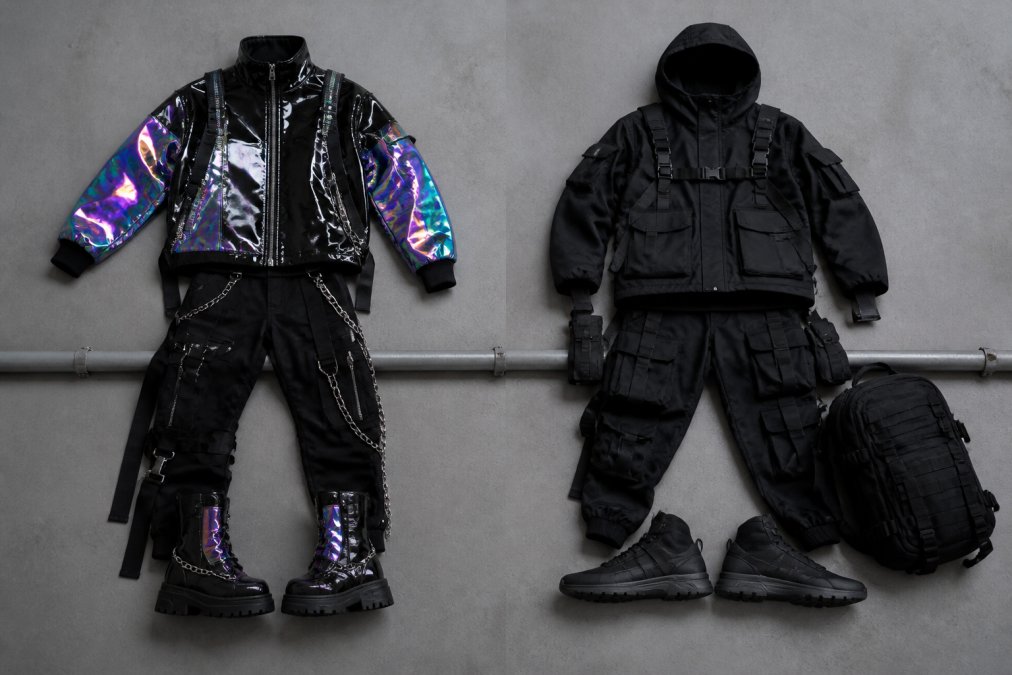
 comparison
Cyberpunk Fashion vs Techwear Style: Key Differences (2026)
Table of Contents
- Cyberpunk Fashion vs Techwear Style: The Core Difference
- Techwear Outfit Essentials: What Actually Goes Into the Look
- Cyberpunk Aesthetics: Neon, Industrial, and Dystopian Style
- Smart Fabric Clothing vs Traditional Cotton: Which Fabric Story Fits Which Style
- Silhouette, Layering, and Construction Techniques That Separate the Two
- Budget-Friendly vs High-End: What You Actually Pay For
- Sustainable Techwear and Cyberpunk: Where Eco-Consciousness Fits
- Can You Mix Cyberpunk and Techwear in One Outfit?
- Frequently Asked Questions
Last Updated: September 12, 2026
Cyberpunk Fashion vs Techwear Style: The Core Difference
Cyberpunk fashion is a narrative-driven aesthetic built on dystopian imagery, neon color, and industrial decay. Techwear is a function-first clothing system built around utility, weather protection, and modular construction. This guide breaks down both so you can tell them apart on sight and decide which fits your wardrobe.
Both styles pull from the same visual well: dark palettes, synthetic fabrics, urban silhouettes, and a futuristic read. The difference sits in intent. Techwear asks what a garment does. Cyberpunk asks what a garment says.
That distinction changes what you buy, how you layer, and how much you spend. Below: the materials, silhouettes, and construction techniques that separate the two, plus how to mix them without looking like a costume.
Techwear Outfit Essentials: What Actually Goes Into the Look
A techwear outfit starts with a shell, adds a mid layer, and finishes with pants and footwear built for movement. The look reads tactical and understated rather than theatrical.
Core techwear outfit essentials:
- Shell jacket with a waterproof membrane and taped seams
- Mid layer in a breathable synthetic or merino blend
- Cargo or tapered technical pants with articulated knees
- Base layer that wicks moisture
- Utility bag with modular attachment points
- Low-profile sneakers or technical boots
Notice what is missing: logos, loud graphics, and decorative hardware. Techwear rewards restraint. A common mistake is pairing one expensive shell with ordinary denim, the silhouette breaks and the outfit reads as a raincoat rather than a system.
The palette stays muted: black, charcoal, olive, gray, and navy. Color comes from a single accent at most.
Cyberpunk Aesthetics: Neon, Industrial, and Dystopian Style
Cyberpunk aesthetics lean into dystopian imagery, industrial texture, and neon color. Where techwear hides its hardware, cyberpunk puts exposed zippers, straps, and buckles on display.
The style draws from science fiction, and that origin shapes everything. You are not dressing for weather. You are dressing for a version of a city that does not exist yet.
Key visual markers:
- Neon accents in cyan, magenta, and acid green
- Industrial textures such as coated nylon and faux leather
- Exposed zippers, straps, and buckles used decoratively
- Graphic tees with bold original artwork
- Layered, asymmetric silhouettes
- Reflective or holographic trim
The most common mistake is going too literal, a full neon bodysuit reads as cosplay. The strongest cyberpunk outfits pick two or three signals and let the rest stay dark and grounded.
Smart Fabric Clothing vs Traditional Cotton: Which Fabric Story Fits Which Style
Smart fabric clothing prioritizes performance through synthetic membranes, durable water-repellent (DWR) finishes, and engineered knits. Traditional cotton prioritizes comfort, breathability, and print surface. The choice comes down to which style you are building, and how the fabric is constructed, not just the fiber.

Techwear runs on synthetics, but "synthetic" is not one thing. The category splits into a few mechanisms:
- Membrane laminates. A thin film (commonly ePTFE or polyurethane) bonded to a face fabric. It blocks liquid water while allowing vapor to pass, which is why a good shell breathes instead of steaming you.
- DWR finishes. A treatment that makes water bead and roll off the face fabric. DWR sheds light rain; the membrane handles sustained weather. It wears off with abrasion and washing and can be renewed.
- Denier and weave. Denier measures yarn thickness. Higher denier generally means a heavier, more abrasion-resistant face fabric; lower denier means lighter and more packable. Ripstop weaves use a grid of thicker yarns to stop tears from spreading.
- Stretch wovens. Fabrics woven with elastane or mechanically engineered without it to move with the body, which lets articulated patterning function.
Cyberpunk is more flexible. It borrows the same synthetic fabrics, then mixes them with cotton, denim, and graphics. That mix makes the style feel lived-in rather than clinical, and is also why cyberpunk outfits often fail in real weather. A coated nylon jacket with no membrane and no sealed seams looks technical but does not perform like technical gear.

The honest trade-off: cotton holds a printed graphic better than most synthetics and breathes well in mild weather, but it does not block rain or wind and dries slowly. Synthetics handle weather but can feel clammy without ventilation, and many are poor print surfaces because ink does not bond to slick or coated faces the way it does to cotton.
For a cyberpunk outfit, a heavyweight cotton tee is often the base layer. AW3SOME CLOTHES INC builds its tees on a 7.5 oz, 245-255 GSM heavyweight body with a smooth print surface that keeps detailed artwork crisp. The oversized, relaxed fit and slight drop shoulder layer cleanly under a shell. Standard colors are 100% cotton; Heather Grey is 90/10 cotton/poly and Charcoal Grey is 50/50.
Silhouette, Layering, and Construction Techniques That Separate the Two
Techwear favors a tapered, body-conforming silhouette with articulated seams and hidden closures. Cyberpunk favors a louder, asymmetric silhouette with visible hardware and exaggerated proportions.
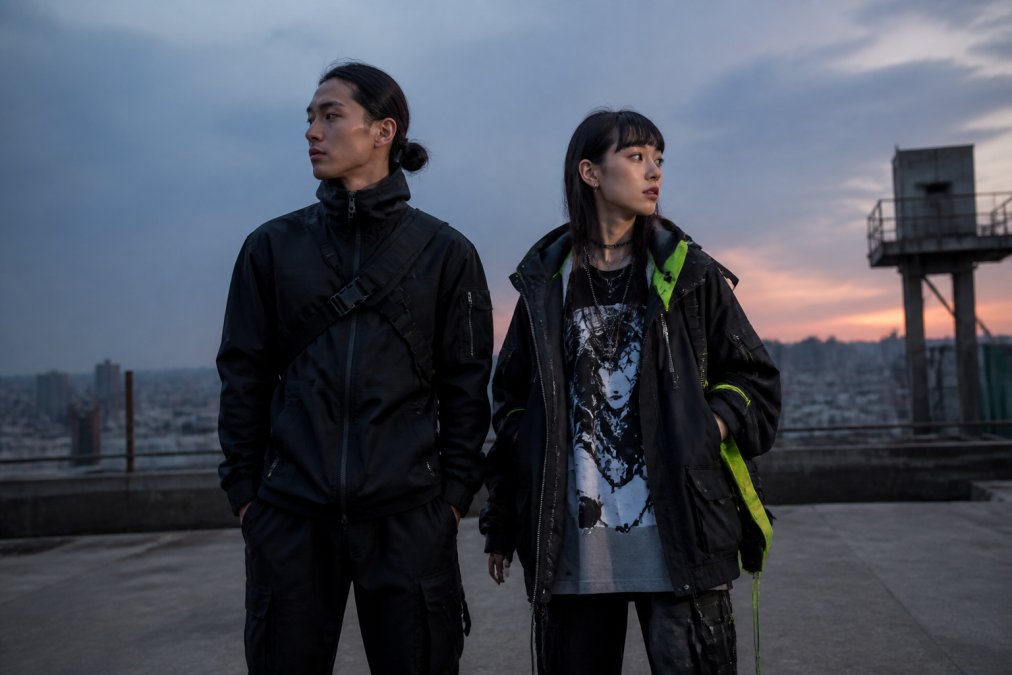
Construction tells you which style you are looking at faster than color does.
| Signal | Techwear | Cyberpunk |
|---|---|---|
| Silhouette | Tapered, body-conforming | Layered, asymmetric |
| Closures | Hidden, sealed | Exposed zippers |
| Hardware | Minimal, functional | Straps, buckles, decorative |
| Palette | Muted, monochrome | Dark plus neon |
| Rare or absent | Bold graphics | |
| Priority | Function | Narrative |
Layering follows the same logic. Techwear layering is a system, base, mid, shell, where each layer does a job. Cyberpunk layering is compositional: you stack pieces for visual effect, and function is a bonus. Techwear relies on articulated seams, gusseted panels, and taped joins so the garment moves with the body. Cyberpunk borrows those techniques but adds surface detail, which is where the industrial read comes from.
Budget-Friendly vs High-End: What You Actually Pay For
The price gap between budget and high-end versions of either style comes down to fabric, construction, and hardware, not just branding. You can build a convincing outfit at either end, but the two styles reward spending differently.
At the budget end, expect basic coated nylon, simple stitching, and plastic hardware. The look can still work, especially for cyberpunk, where visible hardware is part of the point. Limits show up in weather performance and longevity: a budget shell may shed light rain then wet through at the seams, and a budget strap may look right and fail under load.
At the high end, you pay for membrane quality, seam sealing, articulated patterning, and metal hardware. Those upgrades matter most for techwear, where the garment has to perform. For a purely aesthetic cyberpunk outfit, the return is smaller, you are paying for a look, not a capability.
A practical middle path: spend on the shell and footwear, save on the base layer and graphics. A heavyweight graphic tee carries more visual weight than an expensive jacket in a cyberpunk outfit.
AW3SOME CLOTHES INC sits in that middle tier for the graphic layer. Its current tees use a 7.5 oz, 245-255 GSM heavyweight body with shoulder-to-shoulder neck tape, double-needle stitched neck, 1-inch double-needle sleeve and bottom hems, and a stretch-proof collar. Graphics are printed with DTG, which handles detailed artwork well. If you want a starting point, the Midnight Racing Club Tee and the Tokyo Street Racing T-Shirt both carry the neon-and-night-city energy that cyberpunk styling runs on.

The DIY and Customization Angle Most Guides Skip
The cheapest way into either style is not buying more, it is modifying what you already own. Both cyberpunk and techwear have deep DIY roots worth knowing before you spend.
Cyberpunk's visual language grew out of punk and industrial subcultures, where customization was the point, patches, studs, painted hardware, cut-and-sew alterations, and hand-applied reflective tape. Techwear's roots are more commercial, but the same instinct shows in how practitioners modify off-the-shelf gear: adding strap loops, swapping plastic buckles for metal, applying DWR renewals, and layering pieces in unintended ways.
A few approaches that work without a sewing machine:
- Swap the hardware. Replacing a plastic buckle or zipper pull with a metal one changes the read of a piece instantly and costs very little.
- Add reflective or neon trim. Iron-on or adhesive reflective tape on a dark jacket or bag adds a cyberpunk signal without committing to a full piece.
- Layer for silhouette, not for warmth. Stacking a longer tee under a shorter one, or a harness-style strap over a plain shell, changes the shape more than buying a new garment would.
- Repair before replacing. Visible mending reads as intentional in both styles and extends the life of the piece.
This is where the two styles diverge on cost philosophy. Techwear rewards spending on pieces that perform, the shell, footwear, bag. Cyberpunk rewards spending on pieces that carry the story, the graphic layer, visible hardware, accent. On a budget, put money where the style actually reads and modify the rest.
Sustainable Techwear and Cyberpunk: Where Eco-Consciousness Fits
Sustainability sits awkwardly in both styles. Techwear depends on synthetic membranes, which are difficult to recycle. Cyberpunk leans on fast, trend-driven consumption, the opposite of durable. The practical answer is to buy fewer, better pieces and wear them longer, a real environmental argument that also produces better outfits.
A few approaches that work:
- Choose natural fibers where performance is not critical, such as base layers and graphics
- Repair shells before replacing them
- Buy secondhand for statement pieces
- Avoid buying a piece you will wear twice
Cotton has its own footprint and is not automatically the greener choice. No fabric is free of impact. Longevity is the lever most people actually control.
Can You Mix Cyberpunk and Techwear in One Outfit?
Yes, and the mix is often stronger than either style alone. Start with a techwear base for structure, then add one or two cyberpunk signals for character.
The method:
- Build the foundation in muted techwear pieces: tapered pants, a clean shell, technical footwear.
- Add a graphic layer with a bold back print or neon accent.
- Introduce one piece of visible hardware, such as a strap or exposed zipper.
- Stop. Adding a fourth signal pushes the outfit toward costume.
The two styles share a foundation: dark palettes, urban silhouettes, synthetic fabrics. The cyberpunk layer adds narrative; the techwear base keeps it wearable.
For the graphic layer, a piece like the Graphic T-Shirt with the Dark Samurai back print does the job. The heavyweight cotton body and oversized fit sit well under a shell, and the back artwork reads as technical and moody without tipping into cosplay.
The hard part is not understanding the difference between cyberpunk fashion and techwear style. It is building either one without overbuying. Most people start with a statement piece and work backward, which is why so many outfits look unfinished.
AW3SOME CLOTHES INC takes the opposite approach. Every tee is built on a 7.5 oz, 245-255 GSM heavyweight body with an oversized, relaxed fit, a stretch-proof collar, and double-needle stitched hems, so the base layer holds its shape and its print. Original graphics drop constantly and are never reprinted, which means the piece you build around stays yours. Start with the graphic layer and build the rest of the outfit from there. SHOP THE LATEST DROP →
Frequently Asked Questions
What are the key differences between techwear and cyberpunk fashion?
Techwear prioritizes utility and function: articulated seams, waterproof shells, breathability, and a restrained dark palette built for movement. Cyberpunk fashion borrows that same urban, dystopian edge but pushes it toward spectacle, with neon accents, industrial hardware, exposed zippers, and bold graphics. Techwear asks what a garment does; cyberpunk asks what it says. Many people wear pieces from both, but the intent behind the outfit is what separates them.
Is techwear a subgenre of cyberpunk fashion?
Not exactly. Techwear grew from performance apparel and gorpcore, where the goal is real-world functionality. Cyberpunk fashion grew from sci-fi and subculture imagery, where the goal is a futuristic, dystopian look. The two overlap in silhouette and color, and cyberpunk often borrows techwear garments as a base layer. Treat them as parallel styles that share a visual language rather than one being a subset of the other.
Can you mix cyberpunk and techwear elements in one outfit?
Yes, and it is one of the easiest ways to build a futuristic look without committing to one camp. Start with a techwear base: a dark, relaxed heavyweight tee and a tapered or modular pant. Then add one cyberpunk signal, such as a neon accent, a strap or buckle detail, or a graphic back print with a sci-fi or tactical feel. Keep the palette to two or three colors so the layers read as intentional rather than costume-like.
Is cyberpunk fashion still relevant in modern streetwear?
It still shows up, though usually in fragments rather than full outfits. Neon accents, industrial hardware, and dystopian graphics appear across streetwear drops, and techwear's utility details have moved into everyday pieces. The full head-to-toe cyberpunk look reads as costume in most settings. The pieces that last are the ones that borrow one or two signals, like a graphic tee with a technical or armored motif, and let the rest of the outfit stay wearable.
Do you need smart fabric clothing to dress in either style?
No. Smart fabric clothing, meaning textiles with added performance properties, is a techwear talking point, not a requirement. Traditional cotton still carries most cyberpunk and streetwear looks, and it prints graphics cleanly. A heavyweight cotton tee at 7.5 oz (245 to 255 GSM) with a relaxed fit and a stretch-proof collar handles layering well and holds print detail. Choose fabric based on how the garment performs for you, not on the label.