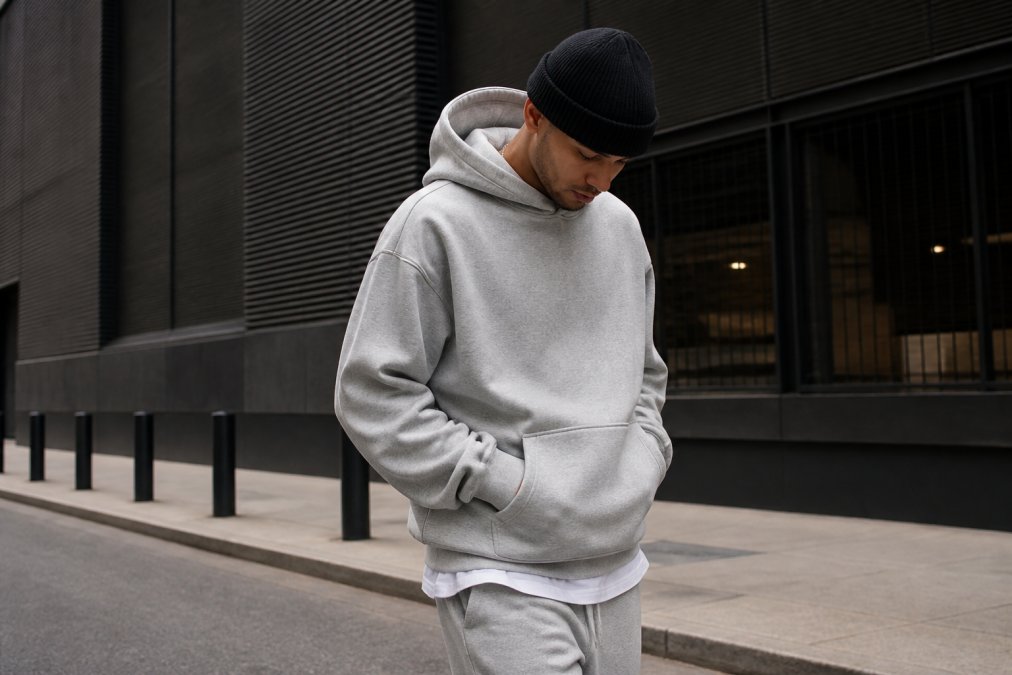
 how-to
How to Style Minimalist Streetwear for Men (2026 Guide)
Table of Contents
- Start with a Wardrobe Assessment: The 3-3-3 Rule
- The Core of Minimalist Streetwear Essentials
- Fabric Science: Choosing Quality Over Quantity
- Mastering Heavyweight T-Shirt Styling
- How to Layer Streetwear Outfits for Depth
- Footwear, Fit, and Finishing Details
- Budget-Conscious Capsule Building and Seasonal Adaptation
- Conclusion: Build Your Uniform, Wear It Daily
- Frequently Asked Questions
Last Updated: September 8, 2026
Minimalist streetwear is the practice of stripping urban fashion down to its essential components: clean lines, neutral tones, and high-quality fabrics that fit well without shouting for attention. Below, we'll show you exactly how to style minimalist streetwear for men using a logical framework that most visual-heavy guides miss entirely.
The biggest mistake most guides make is treating minimalism as a shopping list rather than a system. You do not need twenty new pieces; you need the right ten, worn in combinations that create depth through layering and textural contrast.
Start with a Wardrobe Assessment: The 3-3-3 Rule
Before buying anything, audit what you already own. The 3-3-3 rule is a simple framework: identify 3 outer layers, 3 tops, and 3 bottoms that fit well and share a compatible color story. If a piece clashes with your neutral base of black, white, grey, or olive, it does not belong in the rotation.

This assessment reveals gaps in your capsule wardrobe and prevents redundant purchases. Most men already own the foundation; they lack the specific layering pieces that make minimalist streetwear essentials feel intentional.
A common mistake is keeping ill-fitting items out of guilt. If the shoulders droop past your natural line or the hem hits at an awkward hip point, the garment undermines every outfit. Donate it and replace it.
The Core of Minimalist Streetwear Essentials
A functional minimalist wardrobe revolves around a few versatile categories: heavyweight tees, straight-leg or tapered trousers, a structured overshirt or jacket, and clean footwear. Graphic-free basics form the backbone, while one or two statement pieces provide visual interest without breaking the monochromatic discipline.
The goal is outfit construction, not accumulation. Every essential should pair with at least three other items in your closet.
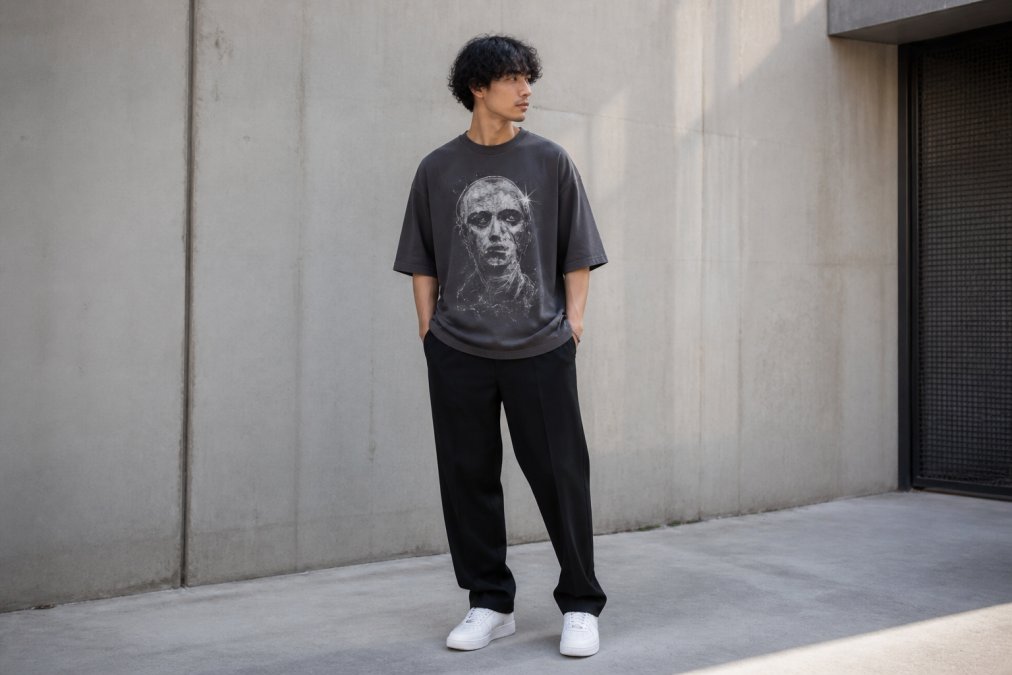
Fit and proportion matter more than brand names. An oversized fit works when balanced by a slimmer bottom half; a relaxed tee paired with baggy pants reads sloppy rather than intentional.
Fabric Science: Choosing Quality Over Quantity
Fabric weight directly affects how a garment hangs, drapes, and ages, but heavier is not automatically better. What matters is whether the material suits the garment's purpose and the season.
Minimalist streetwear styling depends on high-quality fabrics because the lack of visual noise means construction details become the design. A dense 16-singles yarn feels smooth, while quarter-turned construction prevents the side seam from twisting after washing.
When evaluating a potential purchase, ask what the garment is made of and how it was constructed. A 100% cotton tee in a standard colorway offers breathability and a natural hand-feel, while a cotton-poly blend adds resilience. The Textile Exchange materials report notes that understanding fiber origin and blend ratios helps consumers make more informed, longer-lasting purchases. In practice, this means reading the spec sheet, not just trusting the lookbook.
Mastering Heavyweight T-Shirt Styling
The heavyweight t-shirt is the cornerstone of minimalist streetwear, and styling it correctly transforms a basic garment into the anchor of your outfit.
Start with the tuck rule: for a relaxed tee, leave it untucked over straight-leg trousers for an easy look. For a cleaner vibe, tuck the front hem partially into your waistband to define your waist. The drape of a heavier fabric holds the tuck better than flimsy material.
Color coordination begins with the shirt. A muted charcoal or heather grey tee acts as a neutral canvas, while a piece with a minimal front logo and a bold back graphic offers a secondary focal point when you remove an outer layer. The Fashion Institute of Technology's guide to menswear basics emphasizes that mastering a few core garments before experimenting with trend pieces builds a more adaptable wardrobe.

How to Layer Streetwear Outfits for Depth
Layering is what separates a functional minimalist outfit from a flat one. The objective is to build depth through textural contrast and varying hem lengths without adding bulk.
The key to layering successfully is proportion. Each layer should be slightly longer or shorter than the one beneath it to create visual interest.
Seasonal adaptation changes the weight of your layers, not the system. In cooler months, swap a cotton overshirt for a technical outerwear piece with a bit of water resistance. In transitional weather, a single unstructured layer over your tee provides enough warmth without sacrificing the clean silhouette you are after.
Footwear, Fit, and Finishing Details
Most guides stop at "wear white sneakers." That advice is useless without understanding how footwear volume and sole height interact with your specific pant cut and top-layer proportions.
The Silhouette Math of Footwear
Think of your outfit in three visual blocks: top (shoulders to waist), middle (waist to knee), and lower (knee to ground). Your shoe choice dictates the visual weight of the lower block, which must balance the top two.
- Oversized top + straight-leg trouser: You need a shoe with visual mass at the sole. A chunky trainer or a lug-sole boot anchors the wide top block. A slim, low-profile sneaker here makes your feet look small and the outfit top-heavy.
- Fitted top + tapered trouser: A low-profile leather sneaker or a minimalist court shoe keeps the line clean. Adding a chunky sole to an already slim outfit can make your legs look shorter than they are.
- Wide-leg or cropped trouser: The shoe becomes a deliberate focal point. A clean white leather sneaker or a simple canvas shoe works because the exposed ankle and full sole create a clear visual stop.
Fit Rules for Different Body Types
Athletic build (broad shoulders, larger chest/thighs): Your goal is to avoid the "cannonball" effect where a boxy top meets a tapered bottom. Choose straight-leg or slightly tapered trousers that give your thighs room. For footwear, a mid-volume sole bridges the gap between your heavier upper body and the ground.
Slim build (narrow shoulders, lean frame): Your goal is to add structure without looking swallowed by fabric. An oversized tee works, but balance it with a straight-leg or slightly relaxed trouser, not a skinny jean. Footwear with a slightly elevated sole adds presence. Avoid ultra-chunky sneakers that overwhelm your frame.
Taller build (6'1" and up): Your challenge is proportion, not presence. A low-profile sneaker can make you look even longer, so consider a shoe with a bit of sole height. Cropped trousers that show a half-inch of ankle work well with a clean sneaker.
The Ankle Break Rule
How your trouser meets your shoe is a finishing detail most men ignore. The rule: your pant hem should have a single, clean break at the front, just touching the top of the shoe with no bunching. If fabric pools at the ankle, get the hem tailored or commit to a wider-leg cut designed to stack.
Finishing Details That Reinforce the System
- Socks: In minimalist styling, socks are either invisible or intentional. For cropped trousers, a no-show sock keeps the line clean. For a deliberate streetwear look, a heavyweight cotton sock in a matching neutral tone adds a subtle textural block.
- The single roll: Rolling your sleeve once, not twice, shows a sliver of forearm and breaks up a long sleeve line. It signals intentionality without looking fussy.
- Headwear: A simple dad cap or a beanie in a neutral tone adds a top-of-frame anchor. If your tee has a graphic, keep the hat blank. Never pair a graphic tee with a graphic hat.
- The belt: If your trousers have belt loops, wear a belt. A simple black or brown leather belt with a matte buckle is the only option.
Budget-Conscious Capsule Building and Seasonal Adaptation
Competitors tell you to "invest in quality" without explaining how to do that on a realistic budget or how to make those pieces work across seasons.
The Cost-Per-Wear Calculation
Stop looking at price tags and start calculating cost-per-wear (CPW): price divided by the number of times you will realistically wear the item. A graphic tee that loses its shape after 10 washes has a higher cost-per-wear than a heavyweight tee that holds its structure for 100 washes.
The 30-wear test: Before buying any piece, ask yourself: "Will I wear this at least 30 times?" If the answer is no, it does not belong in your minimalist capsule.
The Budget Allocation Framework
Instead of spreading a limited budget across many cheap items, allocate it by frequency of use:
- The daily anchor (40% of budget): Your heavyweight tee or go-to overshirt. This is the piece you reach for 3-4 times per week.
- The seasonal workhorse (30% of budget): Your outer layer. A technical shell or structured jacket extends the wearability of your entire wardrobe.
- The bottom foundation (20% of budget): One or two pairs of straight-leg or tapered trousers in a neutral tone.
- The accent (10% of budget): One statement piece, a graphic tee with a unique back print, a distinctive cap, or a pair of clean sneakers.
Seasonal Adaptation: Material Science Over Weight
The mistake most men make is buying a heavy winter wardrobe and a separate light summer wardrobe. Minimalist styling works because the same pieces transition across seasons when you understand material properties.
Summer (85°F+): The goal is breathability and moisture management. A 100% cotton tee allows air circulation. Look for a relaxed fit that does not cling to the skin, the gap between fabric and body keeps you cooler. Skip the outer layer entirely.
Winter (40°F and below): The system is layering, not heavier single pieces. Your heavyweight cotton tee becomes the base layer, it traps air against your skin. Add a mid-layer like a cotton or wool overshirt, then finish with a technical shell that blocks wind.
Transitional weather (50°F-70°F): This is where most men struggle. The solution is a single mid-layer over your tee, an overshirt, a lightweight hoodie, or a chore coat.
The Fabric Cheat Sheet for Budget Buyers
| Fabric | Best For | Budget Signal | Avoid If... |
|---|---|---|---|
| 100% cotton, 245-255 GSM | Year-round base layer | Dense hand-feel, holds shape | You need quick-dry performance |
| Cotton-poly blend (e.g., 50/50) | Active days, less wrinkling | Slightly slicker surface | You prioritize breathability |
| Merino wool | Cold-weather mid-layer | Fine gauge, no itch | You are allergic to wool |
| Technical nylon/polyester shell | Wind and rain protection | Taped seams, water-resistant zippers | You want a natural hand-feel |
The Seasonal Rotation Schedule
To make your capsule work year-round, rotate your wardrobe in two phases:
- Phase 1 (Spring/Fall): Tee + overshirt + straight-leg trouser. This is your default uniform for 6 months of the year.
- Phase 2 (Summer/Winter extremes): In summer, drop the overshirt and swap trousers for a lighter fabric. In winter, add the technical shell and a heavier mid-layer.
This two-phase system means you only need to own about 10-12 core pieces total.
Conclusion: Build Your Uniform, Wear It Daily
The real challenge of minimalist streetwear is not finding inspiration, it is exercising restraint. A disciplined approach to color, fabric, and fit will serve you better than any trend-chasing haul.
At AW3SOME CLOTHES INC, we build heavyweight tees designed for this exact approach, using dense 245-255 GSM cotton with a relaxed, drop-shoulder fit and original, never-reprinted graphics. Our pieces are made to anchor a capsule or elevate a statement look, with construction details like shoulder-to-shoulder neck tape and double-needle hems that hold up to daily wear.
Get started with AW3SOME CLOTHES INC and build a uniform that works as hard as you do.
Frequently Asked Questions
What is the 3-3-3 rule for men's clothing?
The 3-3-3 rule is a method for simplifying outfit choices with a capsule wardrobe. It involves picking just three colors, three core garments (like a t-shirt, a pair of trousers, and a jacket), and three accessories (like a watch, a cap, and a bag) to create a cohesive look. This forces you to focus on fit and proportion rather than relying on loud prints or excessive branding.
What colors work best for a minimalist streetwear aesthetic?
A muted color palette is the foundation of minimalist streetwear. Focus on neutral tones like black, white, heather grey, and olive. These shades create a monochromatic base that is versatile and easy to layer. When you do add color, choose one accent piece, like a graphic tee with a red emblem, to create a focal point without breaking the clean lines of your outfit.
How do you style heavyweight tees for a minimalist look?
Heavyweight t-shirt styling relies on the garment's structure. An oversized fit with a slight drop shoulder creates a defined silhouette on its own. Pair a heavyweight tee with straight-leg trousers and minimalist trainers for a complete look. The fabric's density (245-255 GSM) helps the tee hold its shape, making it a reliable base for layering under open overshirts or technical outerwear.
How do you build a minimalist streetwear wardrobe on a budget?
Start with a wardrobe assessment and focus on high-quality basics that last. Prioritize a few heavyweight tees in neutral tones over many cheap, thin options. Invest in one good pair of straight-leg trousers and a versatile overshirt. This capsule approach means you own fewer items, but each one has a specific purpose and fits well, which is the core of the aesthetic.