 how-to
How to Choose Durable Graphic Tees for Everyday Wear
Table of Contents
- What You'll Need Before You Shop
- Step 1: Check Fabric Weight and Material Composition
- Step 2: Identify Quality Print Techniques That Resist Cracking
- Step 3: Evaluate Construction Details for Structural Integrity
- Step 4: Choose the Right Fit and Silhouette for Daily Wear
- Best Streetwear Brands for Graphic Tees: What to Look For
- How to Wash Graphic Tees to Prevent Fading and Cracking
- Common Mistakes to Avoid When Buying Durable Graphic Tees
- Frequently Asked Questions
Last Updated: September 10, 2026
What You'll Need Before You Shop
You don't need tools to buy a durable graphic tee, just a short list of things to check on the tag and in the product photos.

Durable graphic tees are shirts whose fabric, seams, and print hold their shape and color through repeated washing and wear. That covers three separate systems, and a shirt can pass one test while failing another.
Before you shop, decide on four things:
- Your budget per shirt
- Whether you want a fitted or relaxed silhouette
- How often you'll wear it (daily rotation vs. occasional)
- Whether the graphic is printed with a method suited to the artwork
Most buyers skip straight to the design. That's the mistake. A great graphic on weak fabric is a shirt you stop wearing in three months.
Step 1: Check Fabric Weight and Material Composition
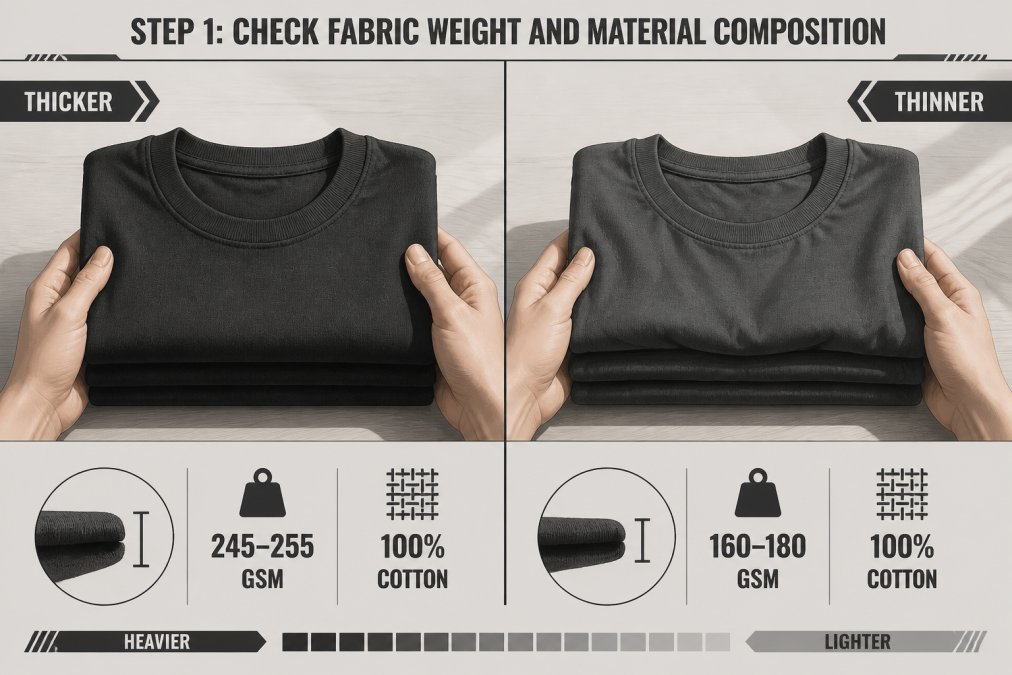
Fabric weight is the fastest quality signal on a product page. It tells you how much cotton went into the shirt, which correlates with how it drapes, how opaque it is, and how long it survives a wash cycle.
Why GSM and Ounces Both Matter
GSM (grams per square meter) and ounces per square yard both state fabric density. American brands usually list ounces; international and wholesale suppliers list GSM. A 7.5 oz shirt and a 245-255 GSM shirt sit in roughly the same range.
Lightweight shirts in the 4-5 oz range feel thin and go sheer under bright light. Midweight shirts around 5.5-6.5 oz are the standard retail default. Heavyweight shirts at 7 oz and up feel substantial, hold a boxier shape, and resist the limp, stretched-out look that kills a graphic tee.
Heavier is not automatically better. A 7.5 oz shirt in July heat wears warmer than a 5 oz shirt. Weight is a trade-off between structure and breathability, not a score.
Cotton, Blends, and What They Mean for Durability
100% cotton gives you the best print surface and the softest hand feel after a few washes. It also shrinks unless the fabric is pre-shrunk or quarter-turned.
Blends behave differently. A 90/10 cotton-poly blend resists shrinking and holds color longer. A 50/50 blend is the most stable but has a drier, less cotton-like hand feel. Neither is worse, they solve different problems.
Ring-spun cotton beats standard open-end cotton on softness and fiber uniformity, which matters because uneven yarn creates weak points that wear through first. Look for "ring-spun" or "16-singles" on the spec sheet.
Step 2: Identify Quality Print Techniques That Resist Cracking
Print durability comes down to two variables: the ink chemistry and how well that ink bonded to the fabric. You can't inspect the bond in a photo, but you can read the method and predict how the graphic will age.
The Three Ink Families and How They Age
Most decorated apparel uses one of three ink types. Each behaves differently in the wash.
Plastisol ink is a PVC-based ink that sits on top of the fabric and cures into a flexible plastic film. It produces opaque, saturated color and is the workhorse of screen printing. Properly cured, it outlasts the shirt; under-cured, it cracks along fold lines within a handful of washes. Hand feel: slightly raised, rubbery when thick.
Water-based ink soaks into the cotton fibers instead of sitting on top, so the print feels like part of the shirt. It tends to fade gradually rather than crack, because there's no plastic film to fracture. It requires more careful curing and works best on 100% cotton.
Discharge ink is a water-based variant that removes the garment's dye rather than adding color on top. Used for light graphics on dark shirts, it produces a very soft, vintage look. It only works on dyeable cotton, so it won't perform the same on poly blends.
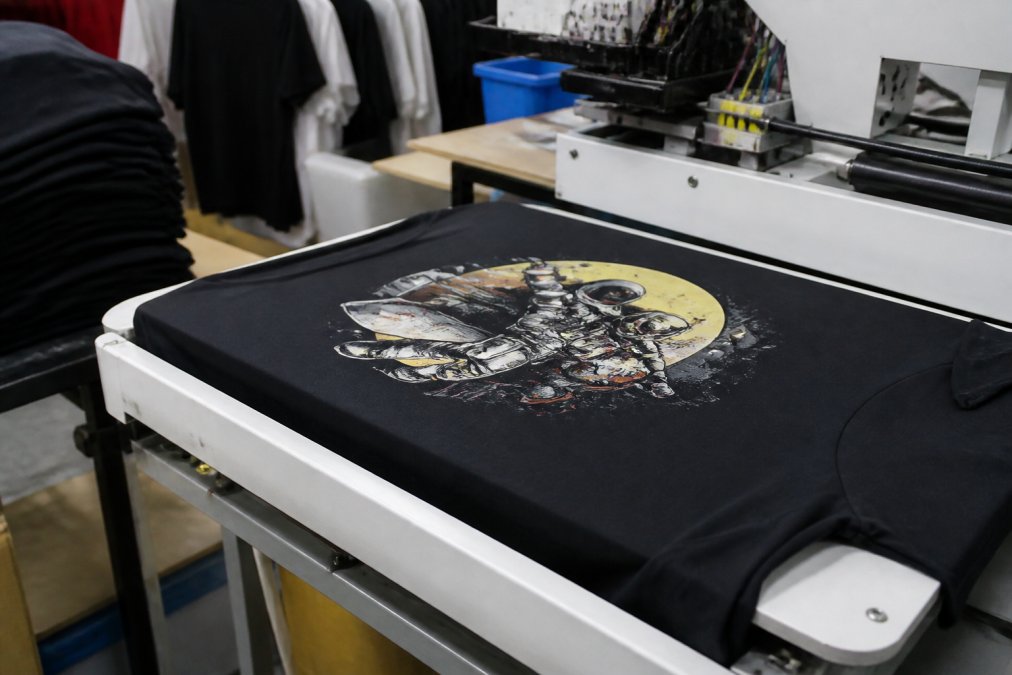
DTG (direct-to-garment) printing uses water-based ink applied like an inkjet printer. It handles full-color, photographic, and gradient artwork that screen printing can't reproduce economically. Because the ink sits close to the surface, DTG depends heavily on correct pretreat and curing. Neither method is inherently inferior: screen printing tends to win on longevity for simple, limited-color graphics, while DTG wins on detail and color range.
A brand that tells you which method and ink it uses is a brand worth trusting.
How to Stress-Test Print Adhesion Before You Buy
Most guides tell you what to look for, not how to test it. You can't wash a shirt you haven't bought, but you can run this sequence on a tee you already own to calibrate expectations, then repeat it on a new shirt the day it arrives, while the return window is open.
- The inside-out inspection. Turn the shirt inside out and look at the back of the print. A well-cured print shows ink that has soaked into the fibers. A plastic film sitting on top with a glossy sheen is a sign of a heavy plastisol layer that may crack.
- The stretch test. Gently stretch the fabric across the printed area. Cracking that appears immediately means the ink is brittle or under-cured.
- The fingernail scratch. Scratch a hidden corner of the print with a fingernail. Ink that flakes off was under-cured.
- The edge lift check. Look at the print edges, where lifting starts first. Any peeling at the border will spread.
- The wash-and-inspect cycle. Wash the shirt once, inside out, cold, and air dry. Re-check steps 1 through 4. A print that survives one wash unchanged is likely to survive many.
If a shirt fails step 2 or 3, it will crack within a handful of washes no matter how carefully you care for it. Run the same test on a shirt you've owned for a year and you'll see the difference between a print that bonded and one that just sat on top.
Step 3: Evaluate Construction Details for Structural Integrity
A shirt can have great fabric and a great print and still fall apart at the seams. Garment construction is where budget brands cut corners, because most shoppers never look.
Check these five points:
- Double-stitched hems on the sleeves and bottom. Single stitching unravels faster.
- Shoulder-to-shoulder neck tape, which stops the back neckline from stretching into a wavy mess.
- Stretch-proof collar or a ribbed collar with enough elasticity to snap back after pulling it over your head.
- Double-needle stitched neck, the seam that takes the most stress when you dress.
- Seam integrity at the armholes, where cheap shirts split first.
Quarter-turned construction is a bonus. It means the fabric was cut and rotated so the shirt doesn't twist around your torso after washing, a problem that makes a straight shirt look crooked.
Step 4: Choose the Right Fit and Silhouette for Daily Wear
Fit determines whether you actually reach for the shirt, and it interacts with durability in ways most guides ignore: a shirt that's too tight stresses the seams and print every time you move, and one that's too loose gets caught, pulled, and washed more often.
Matching Silhouette to Rotation
- Everyday wear: relaxed fit, midweight to heavyweight fabric, neutral base color. The extra fabric in a relaxed cut distributes stress across the print instead of concentrating it at the chest.
- Layering pieces: slightly fitted, thinner fabric so it doesn't bunch under a jacket. Thinner fabric wears faster, so treat these as a shorter-lifecycle purchase.
- Statement pieces: oversized cut, bold graphic placement on the back. Oversized cuts put more fabric through the wash cycle per wear, which is worth factoring into how often you replace them.
Graphic placement matters more than most buyers realize. A large back print limits what you can wear over it and flexes every time you sit down. A compact chest emblem layers under anything and sits on a low-flex area, which tends to extend print life. If you want one shirt to do both jobs, look for a minimal front logo with a larger back panel.

The Durability Trade-Off: Cost Per Wear
Price and durability are not the same thing. A higher price often reflects design exclusivity or brand positioning, not fabric weight or print quality. The useful question isn't "how much does it cost" but "how much does it cost per wear."
Here's the framework, using your own numbers:
- Estimate how many times you'll realistically wear the shirt in a year. A daily-rotation tee might see 50 to 100 wears; an occasional statement piece might see 10.
- Divide the shirt's price by that wear count. That's your cost per wear.
- Adjust for expected lifespan. A shirt with heavier fabric, taped neck seams, and a properly cured print is likely to survive more wash cycles than a thin, single-stitched shirt with a surface print.
A cheaper shirt that fades or cracks after a season can end up costing more per wear than a heavier shirt that lasts several years. The math only works if you're honest about how often you'll actually wear it.
A Quick Fit Checklist Before You Commit
- Does the shoulder seam sit at or slightly past your natural shoulder? A seam that pulls inward stresses the armhole.
- Can you raise your arms without the hem lifting past your waistband? If not, the shirt is too short for everyday wear.
- Does the collar snap back after you pull it over your head? A collar that stays stretched will look worn out long before the fabric does.
- Does the print sit on a low-flex area, or does it cross a fold line where it will crack first?
Fit is personal, but these four checks separate a shirt you'll wear for years from one you'll retire in a season.
Best Streetwear Brands for Graphic Tees: What to Look For
The best streetwear brands for graphic tees publish their fabric specs, name their print method, and show construction details in product photos. That's the whole test. Brands that hide behind moody lifestyle shots and vague words like "premium" are usually hiding thin fabric.
At AW3SOME CLOTHES INC, our tees use the Shaka Wear SHMHSS heavyweight body: 7.5 oz / 245-255 GSM, an oversized relaxed fit with a slight drop shoulder, 16-singles yarn, shoulder-to-shoulder neck tape, a double-needle stitched neck, 1" double-needle sleeve and bottom hems, a stretch-proof collar, and quarter-turned construction. Standard colors are 100% cotton; Heather Grey is a 90/10 cotton-poly blend and Charcoal Grey is 50/50. Graphics are printed with DTG.
Federal Trade Commission guidance on textile labeling and fiber content
That spec list is the point. You can compare it line by line against any other brand's page and see exactly what you're paying for.
How to Wash Graphic Tees to Prevent Fading and Cracking
How to wash graphic tees to prevent fading comes down to three rules: cold water, inside-out, and low heat. Heat kills prints, not washing itself.
Follow this routine:
- Turn the shirt inside-out before it goes in the hamper.
- Wash in cold water on a gentle or normal cycle with similar colors.
- Skip fabric softener. It leaves a residue that dulls prints and coats fibers.
- Tumble dry low or air dry. High heat is the main cause of print cracking and shrinkage.
- If you iron, never touch the iron to the print. Press the reverse side only.
Fading resistance also depends on how you dry. Air drying flat or on a line adds years to a print compared to a hot dryer cycle. If you must use a machine, pull the shirt out slightly damp.
Common Mistakes to Avoid When Buying Durable Graphic Tees
The most common mistake is buying on design alone and never reading the spec sheet. Here's what else trips people up.
Ignoring the care label. A care label tells you what the fabric can survive. If it says dry clean only, it's not an everyday shirt.
Assuming price equals durability. A higher price often reflects design exclusivity or brand positioning, not fabric weight. Check the GSM or ounce count before you assume.
Buying one weight for every season. A heavyweight tee is ideal for fall and winter layering and uncomfortable in peak summer. Rotate weights seasonally.
Skipping the shrinkage question. Unprepared cotton can shrink noticeably on the first wash. Pre-shrunk and quarter-turned fabrics shrink far less.
Never checking the return policy. If a brand won't stand behind fit, that tells you something about how confident they are in their sizing.
Frequently Asked Questions
What fabric weight is best for a durable graphic tee?
Fabric weight between 6 and 8 ounces per square yard (roughly 200 to 270 GSM) holds up well for everyday wear. Heavier fabrics resist stretching and hold their shape through repeated washes, while lighter options may feel cooler but show wear faster. Look for shirts in the 7 to 7.5 oz range if you want a balance of durability and breathability. Always check the care label and feel the fabric in person when possible.
Does the printing method affect how long a graphic tee lasts?
Yes. Screen printing with plastisol ink creates a thick, flexible layer that bonds to fabric fibers. Direct-to-garment (DTG) printing uses water-based inks that sit on the surface. Both methods can last if you wash inside-out in cold water and air dry. Ask the brand which method they use before buying if longevity is your priority.
How can you tell if a graphic tee will hold its shape after washing?
Check the construction details. Double-stitched hems, shoulder-to-shoulder neck tape, and a stretch-proof collar all signal a shirt built to survive repeated washing. Quarter-turned construction prevents the twisting that plagues cheaper tees. Pre-shrunk or ring-spun cotton also reduces shrinkage. If a tee feels flimsy at the seams or the collar rolls easily, it will likely lose shape within a few washes.
How should you care for graphic tees to prevent fading and cracking?
Wash inside-out in cold water on a gentle cycle. Avoid fabric softener, which breaks down ink adhesion. Skip the dryer or use tumble dry low; high heat causes cracking and shrinkage. Air drying preserves print integrity and fabric structure. Never iron directly over the graphic. Following these steps can extend a quality graphic tee's life significantly, keeping the print and fabric looking newer for longer.
Building a wardrobe of shirts that actually last means looking past the artwork and reading the specs. AW3SOME CLOTHES INC prints original graphics with DTG on a 7.5 oz / 245-255 GSM heavyweight body, built with shoulder-to-shoulder neck tape, a double-needle stitched neck, a stretch-proof collar, and quarter-turned construction. Designs are never reprinted, so what you buy stays yours. Shop the latest drop and find a heavyweight tee built for daily rotation.